Skip navigation

The deadline for the Call for Papers for the Academic track at Loncon3 is rapidly approaching: it is 31 December!

For details, see http://www.loncon3.org/call_for_papers.php

The Academic Track, embedded within the World Science Fiction Convention in London, is going to be one of the biggest SF and Fantasy academic conferences of 2014, and it is going to take place at what may be one of the most exciting Worldcons — and certainly one of the biggest — for a long time. The venue is spectacular, and it is close to the Royal Observatory at Greenwich, and the National Maritime Museum in Greenwich (which is hosting a big Steampunk exhibition to coincide with the Worldcon) as well as being an easy trip into the centre of London too, which has, well, one or two interesting places to visit…! By the time of the convention, my own website, www.fantasticlondon.co.uk, will be able to show you all the places in London worth visiting for their connections with science fiction and fantasy.

The range of what is being covered by the academic programme at Worldcon is enormous, not just literary sf but media sf, gaming, fandom, etc: see the call for papers. But we would still like more offerings of papers on literary sf, and we are still interested in attracting papers on the work of the guests of honour: Robin Hobb (Megan Lindholm), the late Iain M. Banks, John Clute, Bryan Talbot, Jeanne Gomoll or Chris Foss. But if you want to come and talk about your speciality, please do send in an abstract!
This interdisciplinary call for papers invites proposals for an edited volume on zombies in comics and graphic novels through the lens of medical discourse.

Like many tropes in science fiction, the zombie crosses discursive boundaries to become a metaphor used in clinical and scientific literature. For example, it becomes a figurative mediation for patients who experience “zombification” and  the “dehumanizing” effects of illness and/or medical treatment, such as the numbing affect of clinical depression or ataxic effects seen in psychiatric patients who perform the “Thorazine shuffle”—a physical side effect that connotes so much more than the inability to ambulate properly. These are medicalized examples of what Daniel Boon’s “The Zombie as Other: Mortality and the Monstrous in the Post-Nuclear Age calls the “cultural zombie,” a non-literal figure of zombification engendered through its cultural milieu. However, metaphor is only one of the many iterations of the medicalized zombie.

Rather than understanding the zombie as a manifestation or representation of medical, technological, and ecological anxieties, this collection will explore how the zombie is also transmuted and complicated in graphic texts. While a central section of the text will address plague, contagion, and epidemiology narratives, we seek to move beyond merely identifying the similarities between the etiology of infectious disease and zombie plagues to question how medical discourse constructs and is constructed by popular iconography of the boundaries of life, illness and health.

Our volume will 1)  addresses how science fiction and popular culture influence medicine as much as biomedicine influences science fiction and popular culture, such as the Center For Disease Control’s use of the zombie in their graphic novel public health campaign pertaining to epidemics; 2) reveal how a trope that has become popular across the entire media spectrum speaks to cultural anxieties pertaining to pathology, ecology, and (bio)medicalization in capacities unique to the graphic medium; and 3) explore how (bio)medicalized zombies are prefigured in earlier forms and then complicated in comics and graphic novels vis-à-vis medical discourse, such as Simon Garth, the workaholic executive who is turned into a zombie by a voodoo cult in the 1944 Menace comic anthology.

Possible topics and questions to explore include

  • How do voodoo zombies prefigure bio zombies? How does their fantastical and racialized etiology complicate the emergence modern medicine after the fin de siècle?
  • How does biomedicine interpret the zombie?
  • How does the comic medium represent or complicate zombies in ways other mediums like film cannot?
  • What does zombification mean in terms of neuroscience? In terms of epidemiology?
  • What are the benefits and risk of using the zombie as a tool for public health? As a metaphor for illness? What kind assumptions do these approaches take? Do these examples reflect or critique actual instances of “living death,” undeath, contagion, or loss of rational agency?
  • What does it mean to feel “like a zombie” when on an anti-depressant, anti-psychotic, or chemotherapeutic agent?
  • How do families treat or perceive dependent loved ones who have had neurological damage from strokes as zombies that consume their time, resources, and lives?
  • Is there a zombification that happens to doctors or medical students as they desensitize their natural abjection to death and affect?
  • How can medicine or illness make one feel other than they are?
  • How is medicine and illness dehumanizing?

While we welcome submission on the ever-popular Walking Dead series, we are especially interested in earlier (1940s-1970s) images of zombies in comics, graphic pathographies, and super hero iterations (e.g. Marvel Zombies).

Please send 500 word abstracts to Lorenzo Servitje (lserv001@ucr.edu) or Sherryl Vint (sherryl.vint@ucr.edu ) by February 10. 2014.

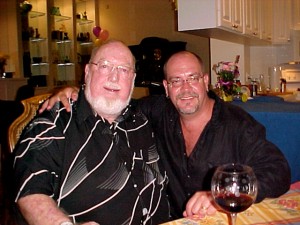
Robert A. Collins and Kevin Crawford

Photo courtesy of Judith Collins McCormick

Long-time ICFA attendee Kevin Crawford passed away this afternoon due to complications due to liver failure. A memorial will be scheduled in Waleska, GA, in the spring. His family will share details with his friends and colleagues as soon as they are able.

Kevin was liked and admired by many in the organization and will be sorely missed.

The International Association for the Fantastic in the Arts presents an annual award and stipend to the graduate student submitting the most outstanding paper at the Association’s conference. The award, and a check for $250, will be presented to the winner at the Awards Banquet on Saturday evening. Students must submit their completed paper (3500 words, excluding bibliography) and verification of student status by February 1. You can find a list of past winners of the Graduate Student Award by following this link: http://fantastic-arts.org/awards/iafa-graduate-student-award/

CRITERIA & INSTRUCTIONS

1. The student will have had a paper accepted for presentation at the Conference. The paper submitted for the competition should be essentially the same as that presented at the conference. The maximum length for entries is 3500 words (about 2 pages over the recommended reading length of 8-9 pages). Students should be aware that funds are limited and that only one award will be given. The paper selected will be published in the Journal of the Fantastic in the Arts, and therefore must not have been previously published or submitted for publication elsewhere. Please note that acceptance of a paper for the Conference does not guarantee an award.

2. It is the responsibility of the student to send a copy of the paper by 1 February 2014 to the 1st VP Dale Knickerbocker (knickerbockerd@ecu.edu), as well as a copy of the letter of acceptance and verification of student status. Submissions may be in Word, RTF or PDF format.

3. The committee is looking for clear, coherent, and interesting writing. Essays should be solidly grounded in scholarly tradition, showing awareness of previous studies and of historical and theoretical contexts. Essays may use any suitable method of analysis, including historical and sociological approaches as well as those that originate in literary theory. Essays will be evaluated for their originality and quality of insight into the text.


The judges for the 2014 award will be:

Cassandra Bausman, University of Iowa

Neil Easterbrook, Texas Christian University

Farah Mendlesohn, Anglia Ruskin University

(abstracts: 30 November 2013, articles: 31 March 2014)

full name / name of organization:
Supernatural Studies Association Journal
contact email:
supernaturalstudies@gmail.com

The Supernatural Studies Journal is now accepting proposals for a themed issue on the supernatural in the nineteenth century (due Winter 2014), guest edited by Janine Hatter and Sara Williams.

Articles may examine any aspect of the representation of the supernatural within the context of worldwide literature, arts and material culture in the nineteenth century. We welcome any approach, but request that authors minimize jargon associated with any single-discipline studies.

Suggested topics include, but are not limited to:
folklore & mythology, monstrosity, hybridity, vampires, shapeshifters, goblins, fairies and fairy tales, ghosts and hauntings, demons and angels, possession and/or mind control, death and dying, burial rites, occult, mysticism, spiritualism and séances, spirit photography, religion, superstition, voodoo, culture, philosophy, desire, politics, gender, race, sexuality and class.

Additionally, we are seeking reviews of books that engage with elements of the nineteenth century supernatural (800-1,000 words in length).

For articles: please send a 300-500 word abstract (or complete article, if available) and C.V. by 30 November 2013. All submissions will be acknowledged. Notification of acceptance will be e-mailed by 15 December 2013. If your abstract is accepted, the full article (3,000 – 6,000 words, including references using MLA style) will be 31 March 2014.

For reviews: please send a C.V. and description of the book you would like to review, or alternatively, see the journal’s website for available books.

Further information, including Submission Guidelines, are available at the journal site: supernaturalstudies.org

Please e-mail submissions to both j.hatter@hull.ac.uk and s.williams2@hull.ac.uk. If emailing the journal directly at supernaturalstudies@gmail.com please quote ‘nineteenth century’ in the subject box.

AHRC funding for UK/EU Arts and Humanities research students
The Midlands3Cities Doctoral Training Partnership will be awarding 410 PhD studentships over a five year period to excellent research students in the Arts and Humanities. The DTP, a collaboration between Nottingham Trent, Nottingham, Birmingham, Birmingham City, Leicester and De Montfort universities, provides research candidates with cross-institutional mentoring, expert supervision, including cross-institutional supervision where appropriate, subject specific and generic training, and professional support in preparing for a career.

Nottingham Trent University is inviting applications from students whose research interests include:

American and British Cinemas
British and American Television
East-Asian Cinemas
Film and work
Postcolonial and Third World cinemas
Political and Third cinema
Experimental/Underground/Avant-Garde film
Gay and Lesbian cinema
European cinemas (especially French and Italian)
Film Theory
Film, television, technology
Cinema and television policy and regulation

The deadline for AHRC funding applications is 9th January 2014, by which time students must have applied for a place to study and have provided two references to a university within the DTP. For full details of eligibility, funding and research supervision areas, please visit www.midlands3cities.ac.uk or contact enquiries@midlands3cities.ac.uk.

Nobel Prize-winning novelist Doris Lessing, 94, died at her home in London on November 17.  Lessing was Guest of Honor for ICFA’s tenth annual conference in 1989, only a year after the conference relocated to Fort Lauderdale, and proved quickly to be one of ICFA’s most accessible and popular guests—working out on the hotel treadmills in the morning, hanging out by the pool in the afternoon, and inadvertently giving rise to one of the conference’s enduring anecdotes.

Lessing had expressed an interest in taking a short cruise while she was in Florida—meaning an ocean day cruise—but ICFA organizers instead booked her on a riverboat called the Jungle Queen, a notorious tourist trap largely for senior citizens, which made its way up the New River past various celebrity homes to a proprietary island, where a rather tacky rib dinner was served on picnic benches to the accompaniment of a live accordion band.  Then-IAFA president Marshall Tymm was appalled, but Lessing, in good spirits, commented that she had learned a good deal more about Florida culture than she had expected.

A few IAFA members kept in touch with Lessing over the next few years, during which she continued to express her support for science fiction and fantasy both in her own writing and in interviews, revealing a knowledge of the field that ranged from Arthur C. Clarke to her friend Brian Aldiss (who had helped arrange her guest of honor appearance) to more contemporary writers like Greg Bear.  Along with Isaac Bashevis Singer, she is one of two ICFA Guests of Honor to receive the Nobel Prize in Literature.

Story and photo courtesy of Gary K. Wolfe

Brown, Wolfe, and Lessing

Charles Brown, Gary K. Wolfe, and Doris Lessing in 1989

Other posts on Doris Lessing:

NYTimes
Telegraph
Washington Post
LA Times
FT
Bloomberg
Margaret Atwood
Justin Cartwright
Eileen Battersby

Conference acceptance letters were sent out on or before November 17th, 2013.  If you have not heard anything yet, please check your spam filter, then contact the appropriate Division Head. Thank you.

Words and words. Dear all, it’s time to think of offering a fantastic/scifi/horror poetry (no prose please!!) reading at the conference! As usual, we have two sessions, 1 hr and 1 1/2 hours, so aim to be able to have a maximum of twelve to fifteen people reading. This always fills up fast, so please let me know if you want to read.

Contact g.wisker@brighton.ac.uk.

See you there!

Gina Wisker

Friday 5th September 2014

University of Westminster

Doctor Who is the BBC’s longest-running drama television series and the world’s longest-running science fiction series. The massive public attention devoted to the show’s 50th anniversary and to its choice of new lead actor confirms that the programme merits serious academic attention. Politics, law and constitutional questions often feature prominently in Doctor Who stories, whether in the form of the Time Lords’ guardianship of the universe, the Doctor’s encounters with British Prime Ministers, or the array of governance arrangements in Dalek society. The show’s politics is also an adventure through time, from the internationalising moralism of the Barry Letts-Terrance Dicks years, the dark satire of Andrew Cartmel’s period as script editor and the egalitarianism of the Russell T. Davies era. Yet the politics and law of Doctor Who have yet to be the subject of wide-ranging scholarship. Proposals for 20 minute papers are therefore invited for a symposium on 5th September 2014, to be held in the University of Westminster’s historic Regent Street building just metres away from BBC headquarters. Possible subjects for papers might include, but are by no means limited to:


• Doctor Who’s ideology

• The Doctor’s political morality

• Comparison of politics of Doctor Who with politics of other

science fiction

• The merits/demerits of Harriet Jones as Prime Minister

• Doctor Who and devolution

• Portrayals of British sovereigns in Doctor Who

• Doctor Who’s politics of class, gender and sexuality

• Fan responses to “political” Doctor Who stories

• International law, intergalactic law and non-interference

• Globalisation and corporate domination

• Satire in Doctor Who

• Politics and law in audio adventures, comic books and novels

• War crimes and genocide

• The politics of UNIT and Torchwood

• The will of villains to secure power

• Political history and political nostalgia in Doctor Who

• Doctor Who’s construction of British national identity


Abstracts should be 250 words in length, and should be accompanied by a 100-word biography of the author. Abstracts should be sent to nicold@wmin.ac.uk – deadline for receipt of abstracts 17 January 2014.